
Managed HA control plane
Loopback operates the Kubernetes control plane in high availability. We take care of operations and updates, you take care of your workloads.
Kubernetes
Create and operate clusters through one platform: HA control plane, private network, scaling groups, and one-click upgrades. You choose provider and location. The platform stays the same.
HA control plane, private networking, and scaling groups.
Managed HA control plane
Loopback operates the Kubernetes control plane in high availability. We take care of operations and updates, you take care of your workloads.
Private networking
Loopback provides your cluster's private network, the same with every provider. Your nodes talk to each other directly over it.
Cilium networking
Cilium is the CNI of the cluster. Loopback operates the managed cluster's private networking with it.
NGINX Ingress
NGINX Ingress routes HTTP traffic to your services. You see Services and Ingress live in the cluster.
Scaling groups
Node groups with auto-scale logic that you tune through multiple parameters. Your cluster grows with the load.
Compute choice
x86/AMD64, ARM, GPU, and bare metal are available. You pick the right combination by provider and region.
One-click upgrades
You roll out new Kubernetes versions with one click, in the maintenance window that fits your operations.
From the control plane at the location you choose to the next upgrade. One operating model for the entire lifecycle.
01
You create the control plane at the location you want.
02
Then you create the nodes, also provider-agnostic, with private networking. The control plane and private network come from Loopback.
03
Auto-scale logic in scaling groups, adjustable individually through multiple parameters.
04
One-click Kubernetes upgrades and maintenance windows.
Access
You copy or download the Admin Kubeconfig and OIDC Kubeconfig right in Loopback. The cluster stays standard Kubernetes, and you work with the tools you already know. Upgrades run through the platform, inside maintenance windows.
Download the Admin Kubeconfig and OIDC Kubeconfig in Loopback or copy them directly.
Standard Kubernetes API. Manifests, Helm charts, and your usual tools work unchanged.
One-click upgrades including maintenance windows.
You can also drive the platform through the versioned REST API, for example from your pipeline.
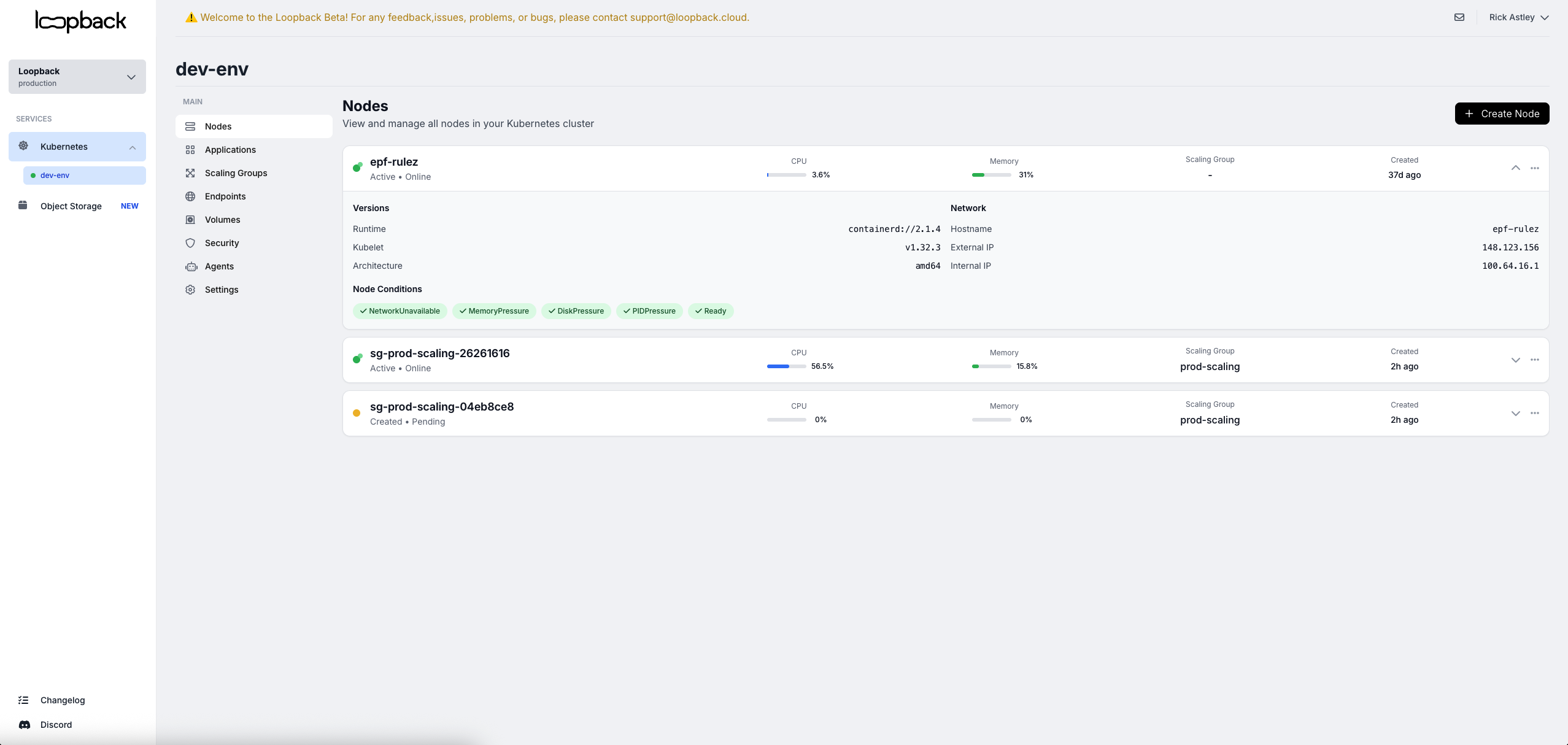
The workspace is the managed cluster in the project. Nodes, scaling groups, workloads, volumes, and endpoints stay in one context.
Create and manage hosts, with power actions, a stored SSH key, cordon/drain, and a web terminal. Node state stays visible in the workspace.
Node groups with auto-scale logic that you tune through multiple parameters. Your cluster grows with the load.
Catalog deployments on the cluster and live workloads through the platform Kubernetes proxy. Applications live in the same workspace as nodes and endpoints.
Persistent volumes in the workspace, including a live view. They stay in the cluster context alongside nodes and endpoints.
Kubernetes Services and Ingress as live networking in the cluster, with Cilium as the CNI and NGINX Ingress as an available ingress option. The load balancer sits in front of the project or directly on the workspace.
Cluster version, control-plane and host upgrades, and patch updates run through the platform. One-click upgrades including maintenance windows.
Admin Kubeconfig and OIDC Kubeconfig to copy or download. The cluster remains standard Kubernetes.
You see node state, CPU, memory, network, scaling groups, and versions at a glance. From the same view you scale, update, and manage your cluster.
Organization, project, and workspace build on each other: teams and access at the top, the managed cluster at the bottom. All in one account.
Account, teams, roles, and SSO. The frame for every resource.
Shared context for clusters, storage, registry, and billing.
The managed Kubernetes cluster. A project can hold more than one workspace.
You choose provider and location per cluster. Interface, permissions, and billing stay the same everywhere.
| Control plane | HA, operated by Loopback |
|---|---|
| Private network | Operated by Loopback |
| CNI | Cilium |
| Ingress | NGINX as an option |
| Storage | Persistent volumes through the provider's CSI driver |
| Upgrades | One-click, including maintenance windows |
Object Storage, Registry, and Bundles share the account and project with the cluster.
The HA control plane is 50€ per month, billed hourly. Workers add on dynamically.
Kubernetes HA control plane
50€
per month, billed hourly Based on 720 hours
Plus dynamic costs for workers
The selected providers supply the infrastructure. Loopback turns it into a platform: managed Kubernetes lifecycle, organizations, RBAC, SSO, REST API, and one bill across all providers. Your operations work the same way everywhere, whichever provider runs your cluster.
Kubernetes fits teams that need containers, portability, scaling, and standard orchestration. You can use Object Storage and Registry without a cluster too, each as a product of its own.
You choose provider, region, and resources yourself. You keep standard Kubernetes access and S3-compatible interfaces, and you can take your data with you at any time through exactly those standard tools.
Migrations run through the familiar Kubernetes, Helm, and registry tools. For assessment and guided migration, you can book our professional services.
Loopback’s platform and core platform data are operated in Germany. The Germany location applies to the platform, not to your workloads. Where workloads run depends on the provider and location you choose.
Send standard questions by email to support@loopback.cloud. We respond Monday to Friday, 09:00 to 17:00 German time. Architecture workshops, migration assessment, and training are separate paid services.
You pay a Platform-Fee for the organization, as Start, Grow, or Scale. Dynamic usage costs add on: workers, Object Storage, Registry, load balancer, traffic, and the Kubernetes HA control plane. Monthly is the same rate times 720 hours, which is 30 days.
Yes. Loopback operates a managed HA control plane.
The platform is provider-agnostic. You choose provider and location per cluster and run every cluster through the same interface, the same API, and the same bill.
Cilium.
Kubernetes upgrades run as one-click upgrades through the platform, including maintenance windows.
x86/AMD64, ARM, GPU, and bare metal are available. You pick the right combination by provider and region.
Persistent volumes come from the CSI driver of the selected provider. You request them as usual with a PersistentVolumeClaim.
Through the versioned REST API. You reach the platform functions in the interface and just as well through the API, with your account's API token and its permissions.